

Despite growing evidence that a hardier maize variety can protect farmers from drought and fall armyworm, most farmers in Kano State are still not planting it, making adoption, not performance, the biggest challenge facing both the state government and the organization promoting the seed.
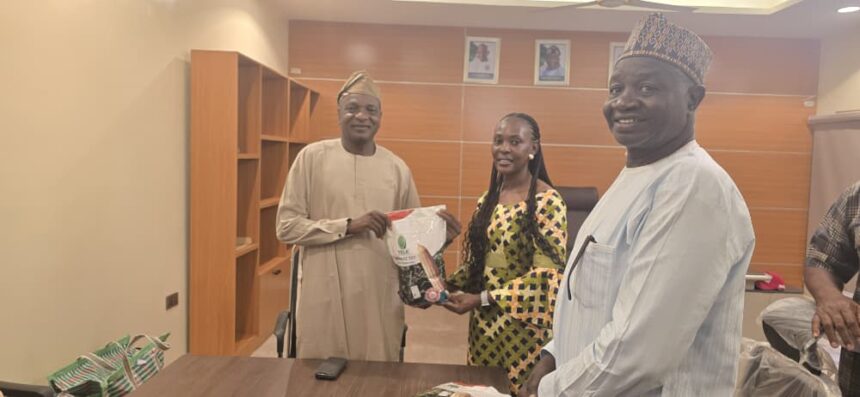
The variety, known as TELA maize and nicknamed the “Insurance Crop,” is already being cultivated by some farmers in Kano, but uptake remains low. Closing that gap was the focus of a recent meeting between the African Agricultural Technology Foundation (AATF) and Kano State Commissioner for Agriculture, Dr. Danjuma Mahmoud.
Leading the AATF delegation, the foundation’s Vice Chairperson of the Board of Trustees, Dr. Sylvia Kyeyune, urged the state government to take a more active role in encouraging farmers to adopt the improved seed.
According to Dr. Kyeyune, TELA maize is designed to withstand drought and naturally resist fall armyworm, one of the most destructive pests affecting maize production across Nigeria. The variety requires less pesticide use, reducing production costs while limiting farmers’ exposure to harmful chemicals and lowering environmental risks.
She said she has visited farms where conventional maize failed completely during poor rainfall while neighboring plots planted with TELA maize continued producing, describing the variety as an “insurance crop” against increasingly unpredictable weather.
Despite those results, many farmers continue to rely on traditional open-pollinated varieties that are far more vulnerable to drought and pests.
Dr. Kyeyune argued that the slow adoption is not due to doubts about the technology itself but because too few farmers have seen its performance firsthand. While demonstrations and training programmes have introduced the seed to some communities, she said they have not reached enough growers to change planting habits on a large scale.
Without stronger government support, she warned, awareness will continue to spread too slowly, leaving a technology capable of significantly improving productivity confined to a small number of farmers.
She said state governments have a unique role to play because farmers are generally more willing to embrace new technologies when they see them being actively promoted by their own governments rather than by development organizations alone.
But awareness, she added, is only part of the challenge.
Even farmers who recognize the benefits of TELA maize may hesitate to invest if they are uncertain about earning a reasonable return on their harvests. While the variety can produce higher yields, fluctuating grain prices can discourage adoption if farmers cannot sell their produce profitably.
Dr. Kyeyune therefore appealed to the Kano State Government to help create a more stable market for maize so farmers adopting improved seed varieties are protected from price volatility.
“Without market assurance,” she said, “the investments made by AATF, seed companies and farmers themselves risk yielding far less impact than they should.”
Responding, Commissioner Mahmoud said improving access to quality seed aligns with Kano State’s broader agricultural development strategy.
He noted that the state is working to strengthen agricultural production not only to improve food security but also to supply its growing agro-processing industry. Kano currently operates four Agricultural Transformation Centres in Dawanau, Kakara, Kura and Bagwai, alongside a major agricultural hub in Kadawa, all of which depend on consistent supplies of high-quality grain.
According to the commissioner, low adoption of improved seed varieties threatens the ability of those facilities to operate at full capacity.
He said the state is prepared to collaborate with AATF to expand adoption of TELA maize, particularly among smallholder farmers, rural communities and women farmers, while building on previous partnerships with development organizations.
Before any formal agreement is reached, however, Dr. Mahmoud requested that AATF submit a concise proposal outlining the scope of the partnership and the responsibilities expected of the state government.
For both AATF and the Kano State Government, the conclusion was clear: the challenge is no longer proving that TELA maize works. The real task is ensuring more farmers are willing to plant it—and confident they can profit from doing so.