

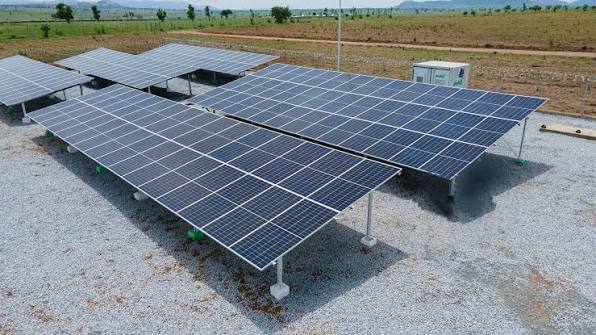
Driven by chronic national grid failures, rising utility tariffs, and crippling fuel costs, households and businesses across Africa are staging an quiet revolution. From the commercial hubs of Nigeria to rural communities across the continent, citizens are declaring energy independence by bypassing centralized utilities altogether, triggering an unprecedented solar expansion that official statistics have largely missed.
A landmark report released Tuesday by energy think tank, Ember and the African Tech Futures Lab reveals that Africa is on track to install a record 17 gigawatts (GW) of solar capacity in 2026, a staggering 45% surge in a single year. The momentum translates to roughly 100,000 solar panels installed every single day.
Rather than waiting for government-led megaprojects, everyday consumers are taking power generation into their own hands through distributed rooftop systems, solar home units, and commercial microgrids.
In countries like Nigeria, where frequent national grid collapses and fuel subsidy removals have made reliance on state infrastructure and diesel generators untenable, rooftop solar has transformed from a alternative option into an economic necessity.
A July report indicated that Nigeria’s solar market hits $2.4 billion, as Africa renewable energy investment attracted over $13.5billion at the time.
The recent report highlights that three-quarters of all solar capacity added between 2023 and 2025 was distributed solar. Because these off-grid systems operate independently, they bypass state monitoring entirely. Consequently, official tracking has severely underestimated the transition: analysts estimate Africa installed roughly 12 GW in 2025, double the figures captured in major international datasets.
“Across Africa, distributed energy resources are rapidly expanding, and in many cases, overtaking grid capacity,” said Joel Nana, Research Director at African Tech Futures Lab. “This transition is chaotic, disruptive, and far from the orderly model planned in national strategies. The choice now is whether these assets remain a parallel system compensating for grid failure or are integrated to unleash wider benefits.”
The boom is rapidly spreading beyond traditional hubs. While South Africa historically dominated regional capacity, it is projected to account for less than 20% of new installations this year as other nations leapfrog outdated grid networks.
The geographic footprint of this energy transition is expanding rapidly across the continent, with thirty-six of Africa’s 54 nations on track to hit record installation numbers in 2026 and 19 countries more than doubling their capacity year-over-year. This rapid surge is particularly pronounced outside traditional markets, led by the Democratic Republic of the Congo, where solar installations are projected to skyrocket by 544%. Zimbabwe is following close behind with a 282% surge, while Egypt and Zambia are bracing for gains of 176% and 117% respectively, underscoring a continent-wide shift as nations leapfrog outdated grid networks.
The 17 GW expected online this year will generate approximately 23 terawatt-hours (TWh) of electricity annually, outpacing the continent’s average annual demand growth over the past decade. In ten nations, including Sierra Leone, Togo, Somalia, and the DRC, 2026 solar additions alone will match 10% to 97% of total current annual generation.
“Africa’s solar revolution is no longer something we’re waiting for. It is happening right now,” said Mohamed Adow, Director of Power Shift Africa, who also added that, “For too long, Africa has been portrayed through the lens of energy poverty. These figures tell another story. Africans are taking advantage of the cheapest energy technology in the world and using our abundant sunshine to generate our own power.”
However, experts emphasize that economic sovereignty must accompany energy liberation. Africa currently imports 94% of its solar panels from China. While domestic manufacturing capacity is set to quadruple to 3.5 GW in 2026 through new factories in Egypt and Tanzania, much of that production is currently earmarked for export. Analysts argue that building localized manufacturing chains will be vital to turning this decentralized solar boom into long-term industrial resilience.