

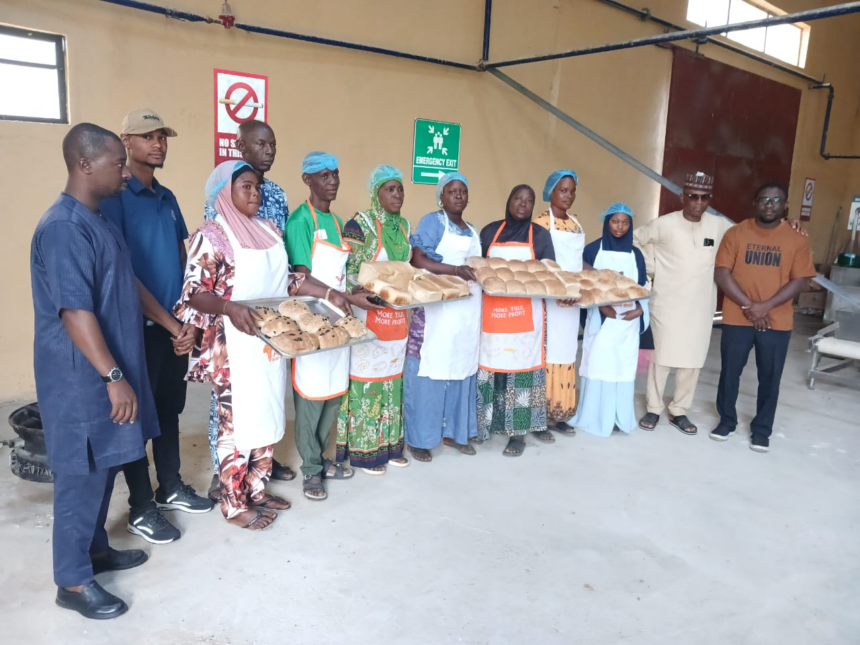
AATF-led coalition accelerating commercial adoption of Cassava bread, set to reduce Nigeria’s heavy dependence on imported wheat
A major coalition led by the African Agricultural Technology Foundation (AATF) has scaled up operations in Nigeria to accelerate the commercial adoption of cassava flour in bread production, a coordinated effort aimed at reducing the nation’s heavy dependence on imported wheat.
The initiative, which is being revived after two decades that it was mulled under President Olusegun Obasanjo and championed by immediate past President of the African Development Bank (AfDB), Dr. Akinwumi Adesina while serving as Agriculture Minister in the Dr. Goodluck Jonathan-led government, aims to actively tackle long-standing supply chain bottlenecks by training local processors to meet strict industrial standards and directly supporting Nigeria’s national policy targeting a 20 percent substitution of cassava flour in commercial baking. Past policy targeted 40 percent inclusion of cassava in flour for bread production.
Mr Samuel Ogunleye, the AATF project coordinator, Cassava Mechanisation and Agro-Processing Project, dislcosed at a recent training of processors that the project, implemented by the Deutsche Gesellschaft für Internationale Zusammenarbeit (GIZ) with funding support from the German Federal Ministry for Economic Cooperation and Development through the Fund for the Promotion of Innovation in Agriculture, aims to promote cassava value addition and improve farmers’ livelihood.
According to him, AATF is partnering a diverse network of national and international partners, linking the scientific expertise of the National Root Crop Research Institute and the Nigerian Stored Products Research Institute with the mechanization capabilities of Agridrive Limited and CLAYUCA Corporation to ensure Nigeria takes maximum advantage in equipping processors with the right knowledge.
“Crucially, the project has partnered directly with the Master Bakers Association to ensure that the final product aligns perfectly with commercial market demands,” he added.
Historically, the widespread adoption of cassava flour by Nigerian bakeries has been choked by inconsistent product quality and fragmented, unreliable supply lines.
Mr. Ogunleye emphasized that upgrading local processor capacity is the critical link required to resolve these legacy bottlenecks and build a sustainable value chain. He revealed that the project has already trained over 500 processors, with a firm target to reach 1,000 before the project concludes.
During the practical sessions in Oyo State, participants were exposed to modern processing techniques and coached on how to successfully bake a diverse range of cassava-infused goods, including standard white bread, coconut bread, fruit bread, and pastries. Mr. Nura Musa, a trainer representing the Master Bakers Association, noted that the program is effectively bridging the historic gap between rural cassava farms and industrial kitchens.
Musa noted that while inconsistent quality and limited technical expertise previously hindered cassava integration into mainstream baking, the ongoing capacity-building efforts are firmly reversing the trend, providing small-scale bakers and commercial bakeries with a reliable, standardized raw material.
He said that the economic implications of this shift extend far beyond the baking industry, adding that successfully substituting a fifth of the nation’s baking flour with locally grown cassava will yield massive macroeconomic benefits, helping to significantly reduce Nigeria’s steep wheat import bill, conserve vital foreign exchange, and spark fresh economic opportunities for rural entrepreneurs.
For the local processors participating in the program, the impact is already tangible, as many of them said that the training has immediately boosted their productivity and expanded their market access, successfully transitioning cassava from a traditional backyard subsistence crop into a lucrative, high-demand industrial raw material.