

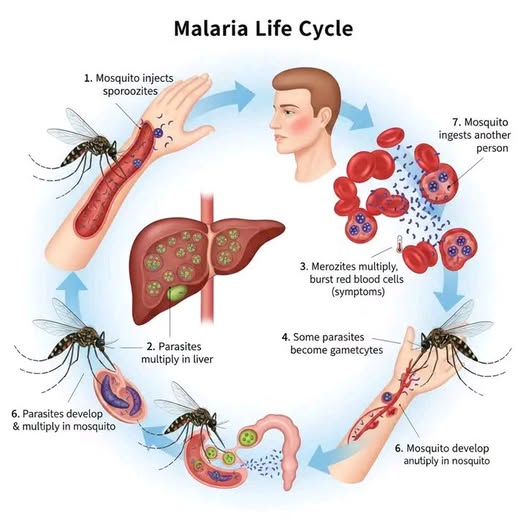
Africa’s battle against malaria has reached a critical juncture that puts science at the heart of the continent’s response. With malaria cases surging amid dwindling fundings, African leaders are calling for a science-led and sustainably financed approach to end the disease that still kills nearly 600,000 people annually, most of whom are children under five years old.
The call was made at the 39th African Union (AU) Summit in Addis Ababa, where the 2025 Africa Malaria Progress Report was unveiled. The report, presented by Duma Gideon Boko, paints a sobering picture: Africa recorded 270.8 million malaria cases in 2024—96% of global cases—and 594,119 deaths (97% of the global total).
In a declaration to this effect, President Boko said, “We stand at a scientific crossroads and we have the knowledge, tools, and technologies to defeat malaria, but only if we sustain the investments that make science work for Africa.”
The report warns that a 30% reduction in malaria funding would cripple prevention efforts, leading to 146 million additional cases, 397,000 more deaths, and economic losses exceeding US$37 billion by 2030. Yet it also shows that Africa’s greatest opportunity lies in scaling up scientific innovation and locally driven research to strengthen health resilience.
Since 2000, malaria control efforts have averted 1.64 billion cases and saved 12.4 million lives, achievements largely attributed to scientific breakthroughs in vector control, diagnostics, and drug therapy. But without renewed funding, the continent risks reversing decades of progress.
Meanwhile, scientific innovation is reshaping how malaria is controlled, treated, and prevented across Africa. Major advances as highlighted in the 2025 report include Next-generation vector control, which hinted that, by 2025, 74% of all insecticide-treated bed nets distributed in Africa were dual-action, next-generation nets, compared to just 20% in 2023. These are 45% more effective against resistant mosquito populations.
It also disclosed that twenty-four African countries are now using World Health Organisation-approved malaria vaccines for children under five, delivering 28.3 million doses in 2025, nearly triple the 2024 figure, while two space-based repellents, the first new vector control interventions in decades have been prequalified by WHO, offering innovative protection for high-risk populations.
The report also highlighted the adoption of targeted chemoprevention. In this case, it disclosed that a record 22 countries implemented seasonal malaria chemoprevention in 2025, guided by real-time data and predictive modeling.
“Tanzania has placed science at the center of our malaria response. At the Ifakara Health Institute, scientists are pioneering gene drive technologies to stop mosquitoes from transmitting malaria. This is African science, led by African minds, solving African problems,” Samia Suluhu Hassan, Tanzania’s Vice President said.
African leaders also emphasised that scientific self-reliance, through local research, production, and innovation, is essential for long-term malaria elimination. Currently, the continent imports 99% of its vaccines and 95% of its medicines, a dependence that weakens access and affordability.
In response, Nigeria and other countries are investing in local manufacturing of antimalarial drugs, rapid diagnostic tests, and insecticide-treated bed nets, signaling a shift toward regional innovation ecosystems.
The African Medicines Agency, now ratified by 31 countries, is harmonizing regulations to accelerate approval of new health technologies across Africa, a vital step toward scientific sovereignty.
To sustain these innovations, African leaders are urging for a “new era of malaria financing” that integrates research funding with health system strengthening. They reaffirmed commitments to mobilize domestic resources and called on global partners to revive the World Bank, which between 2005 and 2010 mobilised over US$1 billion for malaria control and capacity building.
“Every dollar invested in malaria research and the Global Fund yields a nineteen-fold return. Fully deploying next-generation tools and scaling local science could save 13.2 million lives and boost Africa’s economy by US$140 billion in the next 15 years,” Chief Executive Officer at the Roll Back Malaria (RBM) Partnership to End Malaria said.
The 2025 report calls for data-driven malaria control, urging governments to harness artificial intelligence, genomic surveillance, and climate modeling to track mosquito resistance and predict outbreaks.