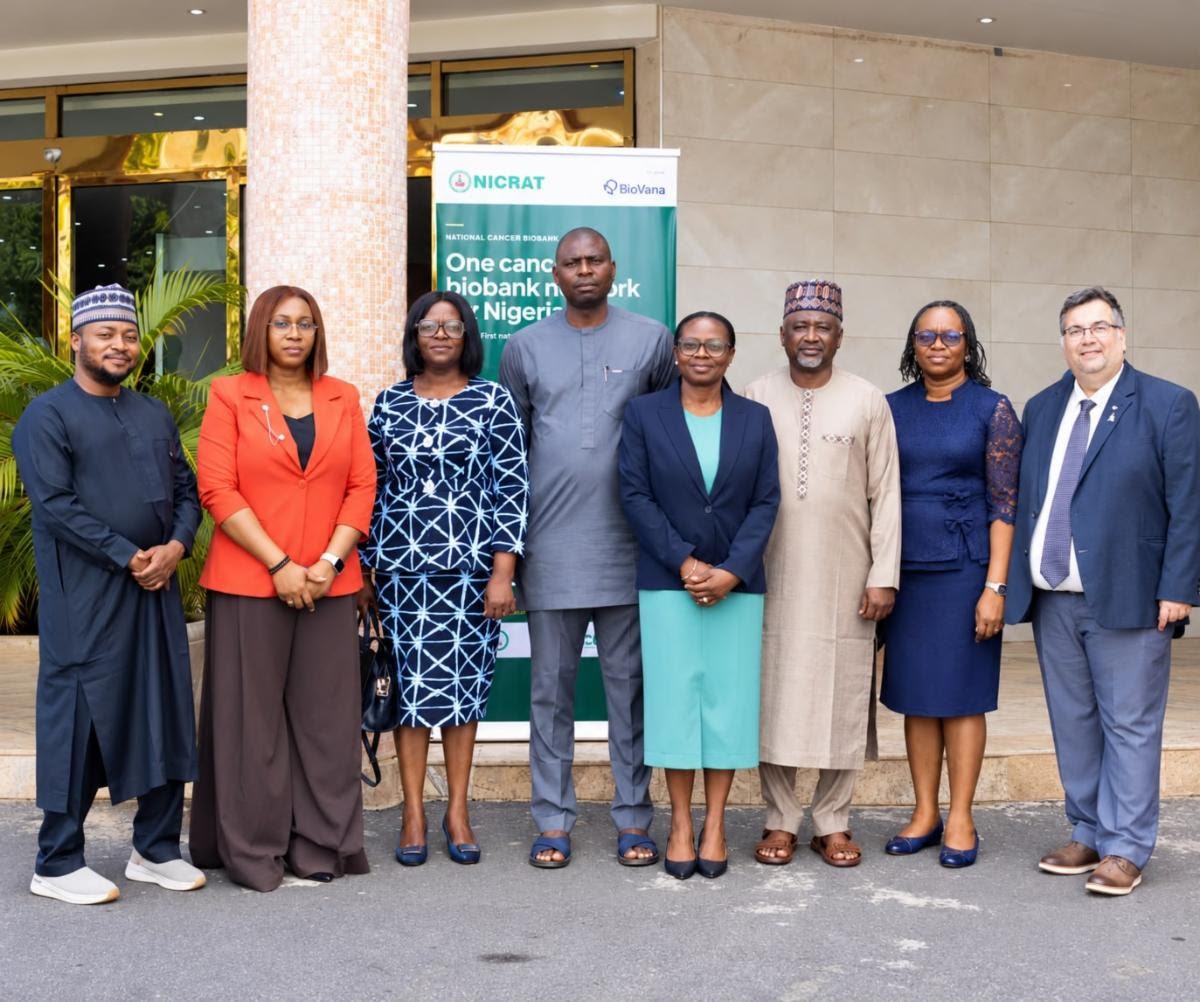
Health data infrastructure company BioVana has partnered with the National Institute for Cancer Research and Treatment (NICRAT) to begin the implementation of Nigeria’s National Cancer Biobank Network (NCBN). The milestone initiative aims to strengthen precision oncology and establish connected, standardized biomedical research infrastructure across the country.
The launch builds on a 2025 Memorandum of Understanding between BioVana and NICRAT. Currently, eight federal hospitals across Nigeria’s six geopolitical zones have joined the nationally coordinated network. The initiative’s initial phase targets the recruitment and cataloging of 10,000 cancer biospecimens, with plans to expand the repository to 100,000 samples by 2028.
Under the partnership, NICRAT provides national leadership, institutional coordination, and general oversight. BioVana leads technical implementation, focusing on digital infrastructure development, sample and data management standards, capacity building, and creating research-ready systems within participating institutions. Following initial site assessments and a stakeholder workshop featuring representatives from the World Health Organization (WHO) and the International Society for Biological and Environmental Repositories (ISBER), the network is advancing toward harmonized biobanking practices and shared quality standards.
As one of Africa’s first nationally coordinated cancer biobank networks, the NCBN establishes a new model for research infrastructure across the continent. Founded in 2025 by Estelle Dogbo and Dr. Jumi Popoola, BioVana aims to connect African research institutions with the global scientific community, enabling local biomedical data to contribute directly to drug discovery and help close the diversity gap in global health research.
Estelle Dogbo, Co-Founder and CEO of BioVana, highlighted that Nigeria already possesses substantial cancer research resources distributed across institutions, and the NCBN serves to link those assets through unified standards, governance, and infrastructure. She noted that the overarching vision is for the network to serve as a blueprint for nationally coordinated biomedical research infrastructure across Africa, demonstrating how countries can responsibly unlock biomedical resources for global discovery.
The initiative comes at a critical time for cancer care in the region. According to Africa Cancer Control Partners, over 1 million new cancer cases were reported on the continent in 2020, a figure projected to double to 2 million over the next 15 years. These statistics underscore the urgent need to expand research capabilities and leverage biobanking to drive breakthroughs in precision medicine.
Professor Usman Malami Aliyu, Director General of NICRAT, explained that the initiative lays the foundation for a national cancer research infrastructure designed to serve Nigeria for generations. He added that the NCBN represents a crucial step toward establishing a central national cancer biobank supported by a robust network of domestic institutions, positioning Nigeria as a regional leader in precision oncology.
International experts also emphasized the network’s global importance. Dr. Stella Somiari, President of ISBER, noted that high-quality, standards-aligned biobanking forms the foundation of trustworthy research, allowing Nigerian institutions to collaborate internationally as equal partners while protecting participants. Similarly, Dr. Zisis Kozlakidis, Group Head of Laboratory Support, Biobanking, and Services at IARC/WHO, affirmed that ensuring high-quality samples from African populations contribute to scientific discovery is essential for building a more representative and equitable future for global cancer research.
Moving forward, the next phase of implementation will center on continued capacity building across the eight participating federal hospitals, harmonizing biobanking procedures, establishing common data standards, and initiating the collection of the first 10,000 biospecimens.