Nigeria’s Federal Ministry of Innovation, Science and Technology (FMIST) and the United Nations Educational, Scientific and Cultural Organization (UNESCO) have called for expanded domestic research financing and stronger cross-border scientific partnerships to accelerate sustainable national development.
Confronted with persistent infrastructure deficits and low public expenditure on research and development, science leaders warned at a joint commemoration in Abuja that Nigeria risks trailing global knowledge economies unless scientific evidence directly guides national planning.
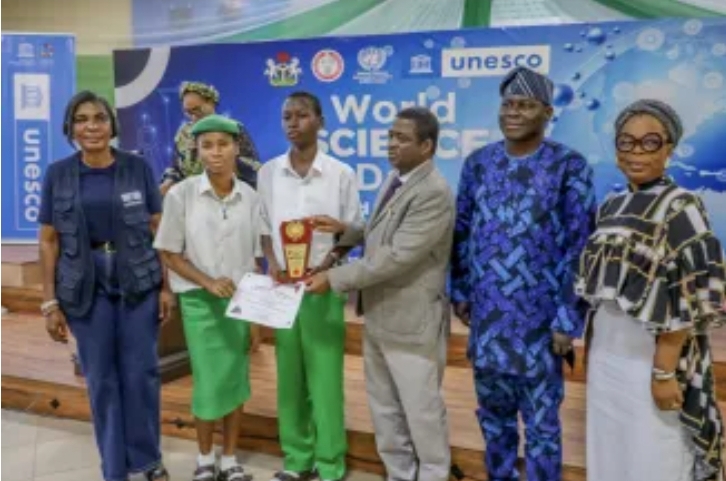
In his message to the event marking World Science Day for Peace and Development under the theme “Common Ground through Science Diplomacy”, Minister of Innovation, Science and Technology Dr. Kingsley Tochukwu Udeh noted that international scientific cooperation remains vital to solving shared regional challenges in health, agriculture, and climate resilience.
Nigeria currently spends less than 0.3 percent of its gross domestic product on research and development, leaving public research institutes heavily reliant on intermittent budgetary allocations and external donor grants.
Millions of citizens continue to face preventable economic and health bottlenecks that locally funded scientific research, indigenous technology transfer, and stronger academic-industry linkages could resolve.
Yet over 75 percent of laboratory prototypes developed across Nigerian universities and federal research agencies stall before commercial production due to inadequate venture financing and fragmented institutional coordination.
Among domestic research institutes, aging laboratory equipment and limited international mobility grants frequently slow down collaborative breakthroughs with global scientific peers.
With emerging technologies reshaping global trade and security, science policy experts emphasize the adoption of formal science diplomacy mechanisms as a direct way to bridge this gap.
UNESCO representatives in Abuja stated that by embedding scientific attachés within diplomatic missions and harmonizing bilateral research agreements, Nigeria can unlock shared computing infrastructure, joint patent frameworks, and technical training for young researchers.
Dr. Udeh, however, stressed that international partnerships must complement rather than replace committed domestic funding.
“True technological sovereignty requires consistent national investment in our own researchers and laboratories so that international collaboration strengthens local capacity,” he said, urging state governments, private industry, and legislative committees to prioritize dedicated research grants that deliver measurable benefits to everyday Nigerians.
The ministry is also calling on federal research agencies, tertiary institutions, and science academies to align their annual research agendas with national industrial priorities and expand public science communication nationwide.
Nigeria and UNESCO Push for Increased Research Investment and Science Diplomac
Leave a Comment
Leave a Comment

Nigerian Scientist Offers New Insight on Deployment of Space Tech for Environmental Sustainability
A female Nigerian scientist has provided a new perspective on how space science and…

WHO Offers COVID-19, Ebola Support To Liberia
The World Health organisation (WHO) has reached out to Liberia with interventions aimed at saving…

Nigeria’s President Seeks Review of Country’s Space Programme
Nigeria’s President Seeks Review of Country’s Space Programme Nigeria’s President, Muhammadu Buhari, has urged the…